_edited.jpg)
Dance Classes Near Me: A Parent’s Guide to Creative Movement in Singapore (2026)
What if the most important part of a dance class isn't a perfect pointed toe, but the spark of confidence that lights up your child's eyes? As you begin searching for dance classes near me, it's easy to feel overwhelmed by a sea of technical requirements and rigid exam schedules. You likely want more than a repetitive routine; you're looking for a safe, warm space where your little one can sway, spin, and discover their own unique rhythm. We believe that early childhood is a time for "little sparks" of joy rather than the pressure of performance.
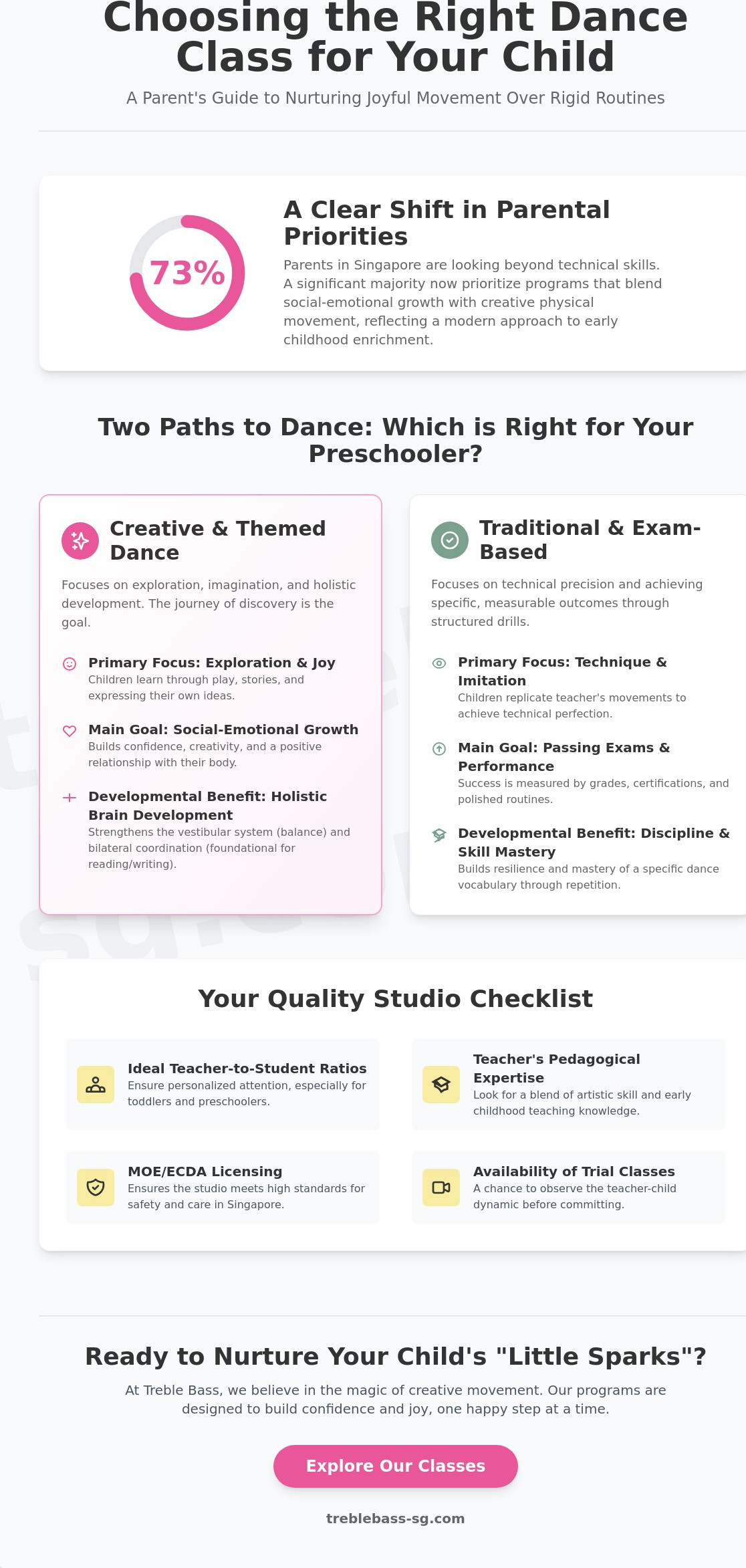
We understand the hesitation many parents feel when navigating an enrichment sector that has grown 8.7% annually since 2021. You aren't alone in seeking a gentler path, as 73% of parents now prioritize programs that balance social-emotional growth with physical movement. This guide will show you how to choose a program that nurtures your child's development through joyful, creative movement. We'll explore the developmental benefits of dance, clarify the difference between technical exams and imaginative play, and provide a clear roadmap for your child's enrichment in 2026.
Key Takeaways
Learn how to navigate the vibrant Singaporean landscape to find high-quality dance classes near me that fit your family’s busy schedule and local needs.
Understand the "magic" of creative movement and how rhythmic swaying supports your child's vestibular system and overall brain development.
Discover why themed, story-based dance programs can be more beneficial for preschoolers than rigid, exam-focused technical training.
Identify the essential markers of a quality studio, including the ideal teacher-to-student ratios and the blend of artistic and pedagogical expertise required for young learners.
Explore how a holistic, "inside-out" approach to movement can nurture your child's "little sparks" of confidence and creativity.
Table of Contents Finding the Right Rhythm: The Landscape of Dance Classes in Singapore The Developmental Magic of Creative Movement for Preschoolers Themed Dance vs. Traditional Ballet: Which Path for Your Child? What to Look for in a Quality Kids’ Dance Studio in Singapore Starsteps at Treble Bass: Nurturing Your Child’s Little Sparks
Finding the Right Rhythm: The Landscape of Dance Classes in Singapore
Searching for dance classes near me often feels like looking for a second home for your child. It's a search for a community where your little one's first tentative steps can transform into confident leaps of joy. Singapore's early childhood enrichment sector has flourished recently, reaching an estimated market value of SGD $1.2 billion in 2025. This growth reflects a beautiful shift in how we view extracurricular activities. For many families, dance is no longer just a weekly appointment; it's a vital part of a child's developmental journey. Whether you're exploring boutique studios in Holland Village or looking at community centers in the Heartlands, the options are as vibrant as the city itself.
While government-subsidized programs like ActiveSG provide wonderful accessibility for older children and adults, the tender years between ages one and six require a more delicate, pedagogical touch. Specialized private enrichment centers often provide the smaller teacher-to-student ratios that toddlers need to feel safe and seen. In Singapore, any center catering to ten or more students must be registered with the Ministry of Education (MOE), and those serving children under seven require an Early Childhood Development Agency (ECDA) license. These regulations ensure that the environment where your child sways and spins meets high standards of safety and care.
The Evolution of Dance Enrichment in Singapore
The days of rigid, exam-only instruction are giving way to a more nurturing philosophy. While traditional ballet exams still have their place, 73% of parents in 2026 now prioritize programs that offer a balance of social-emotional and creative development. This shift aligns with the broader principles of Creative education, which values imagination as a tool for critical thinking. We see this reflected in the "Nurturing Early Learners" (NEL) framework, which encourages holistic growth. Instead of just imitating a teacher's movements, children are now encouraged to explore how their bodies move through space, sparking a sense of agency and wonder from a young age.
Logistics and Accessibility in the Heartlands
We know that for busy Singaporean families, proximity is everything. Finding dance classes near me that fit between school pick-ups and family dinners is a logistical puzzle. Many parents find that central hubs offer specialized, themed programs, while neighborhood community clubs provide convenient entry points. The "trial class" culture is particularly strong here, with trial fees typically ranging from $30 to $50. These sessions are essential because they let you observe the "spark" between the teacher and your child. Most studios operate on a term-based enrollment, often aligned with the school calendar, which helps create a steady, predictable rhythm for your child's weekly routine.
The Developmental Magic of Creative Movement for Preschoolers
When you search for dance classes near me, you're often looking for more than a place to drop off your child for an hour. You're seeking a space where their natural curiosity can take flight. Unlike traditional performance-based styles that prioritize polished routines, Creative Movement is a child-centric pedagogy. It focuses on exploration over imitation. In this nurturing environment, a child doesn't just learn to copy a teacher's step; they learn to understand how their body moves through space. It's a fertile environment where movement becomes a language of discovery.
The simple act of rhythmic swaying, for instance, is a powerful tool for developing a toddler's vestibular system. This system, located in the inner ear, is responsible for balance and spatial orientation. When children sway, spin, and tilt during a session, they're strengthening the neural connections that help them feel grounded and secure in their movements. This physical exploration has profound cognitive benefits. Bilateral coordination, which is the ability to use both sides of the body in a synchronized way, is a key predictor for future academic success. The same brain pathways used to coordinate a skip or a cross-lateral reach are the ones your child will eventually use for handwriting and reading. These little sparks of physical mastery are the foundational building blocks of literacy.
Physical Milestones: Beyond Just Pointing Toes
Beyond the joy of movement, these classes help preschoolers hit vital gross motor milestones. Activities like galloping, hopping, and balancing aren't just play; they're essential for building core strength and posture in our digital-native generation. In a city like Singapore, where space is a premium, developing spatial awareness is crucial. Children learn to navigate Singapore's diverse dance scene by understanding their "personal bubble" while moving in unison with others. This helps them move with confidence and grace in any environment.
Cognitive and Emotional Growth
The integration of music and movement sparks neuroplasticity, creating new neural pathways in young, hungry brains. This is why we see a projected 62% increase in neuroscience-based enrichment offerings by 2026. In a safe, non-judgmental studio, children build the confidence to express their emotions without words. They learn to share space and collaborate with peers, fostering a sense of community that extends far beyond the classroom walls. If you're curious about how these elements come together, you might enjoy exploring our holistic movement programs which celebrate every child's unique journey.
Themed Dance vs. Traditional Ballet: Which Path for Your Child?
In Singapore, the desire to give our children a head start is deeply ingrained. We often see parents searching for dance classes near me with a specific goal in mind: the first ballet certificate. It's a natural instinct to want measurable progress. However, there's a growing conversation about whether a rigid, exam-focused environment is truly the best fit for a three-year-old's spirit. While traditional ballet provides a wonderful foundation of discipline, the "discovery-ready" mindset of themed dance often sparks a more sustainable love for movement during these formative years. It's about choosing between a path of imitation and a path of imagination.
Understanding the Pressure of Early Certification
Many studios in Singapore follow the Royal Academy of Dance (RAD) or Commonwealth Society of Teachers of Dancing (CSTD) syllabi. These are prestigious frameworks, but they require a level of technical precision that can be developmentally taxing for children under five. Forcing a toddler to focus on the perfect turnout or a specific arm position can sometimes stifle their natural joy. We've observed that when technical pressure is applied too early, children may experience burnout by age seven; the very age when their physical coordination is finally ready for more complex training. It's vital to balance our parental expectations with the child's actual physical readiness, ensuring that the "spark" of dance doesn't fade under the weight of a syllabus.
The Power of Imaginative Play and Storytelling
This is where themed dance, such as our Starsteps program, offers a beautiful alternative. Instead of repetitive drills, we use stories to engage a child's imagination. When a child "reaches for a star" or "creeps like a hungry caterpillar," they're performing complex movements like stretching and weight shifting without even realizing it. This approach makes kinesthetic learning feel like a joyful adventure. There's also a powerful connection between rhythmic storytelling and language acquisition. Whether it's through English or Chinese immersion, moving to a narrative helps children internalize vocabulary and auditory patterns more deeply.
By using whimsical props like colorful scarves or gentle drums, we create a fertile environment for sensory exploration. A nurturing expert understands that by building confidence first, the technique will follow naturally as the child grows. We believe in nurturing from the inside out, creating meaningful connections that last a lifetime. When you look for dance classes near me, consider a space that values the wonder of childhood as much as the art of the dance itself.
What to Look for in a Quality Kids’ Dance Studio in Singapore
Finding the right dance classes near me involves more than a quick map search. It's about finding a sanctuary where your child’s potential is celebrated. A high-quality studio should feel like a second home, balancing professional expertise with maternal empathy. In Singapore, the regulatory landscape ensures a baseline of safety. For instance, enrichment centers with 10 or more students must register with the Ministry of Education (MOE). If the studio caters to children under seven, a Childcare Centre License from the Early Childhood Development Agency (ECDA) is required. These are non-negotiable markers of a professional environment that parents should verify before enrolling.
Beyond the paperwork, look at the teacher’s qualifications. The best educators possess a blend of artistic background and early childhood pedagogy. They should understand kinesthetic learning and how it sparks brain development. Class size is another critical factor. In a bustling city like Singapore, smaller teacher-to-student ratios ensure that your toddler isn't just a face in the crowd. Smaller groups allow for the "meaningful connections" that help a child feel safe enough to explore their own movements. Safety also extends to the physical space. Sprung floors are essential to protect growing joints, and equipment should be specifically designed for little hands and feet.
Nurturing Pedagogy vs. Rigid Instruction
A "vibe check" is perhaps the most important part of your trial class. Observe the teacher's emotional style. Is the atmosphere one of rigid instruction or joyful purpose? A nurturing expert uses maternal empathy to guide a shy child who might be hesitant to step onto the dance floor. During your trial, ask the teacher how they handle a child who refuses to join in. A great answer focuses on patience and gentle encouragement rather than force. We believe that when a child feels secure, their natural curiosity will eventually lead them to join the dance. It’s about nurturing from the inside out.
Studio Environment and Community
The physical environment should be a fertile musical learning environment. This means more than just cleanliness; it's about the energy of the space. Does it spark joy? In infant and toddler classes, look for opportunities for parent-child bonding. These shared moments of swaying and laughter create lasting memories and strengthen your family connection. If you're looking for a space that prioritizes your child's holistic well-being, view our nurturing studio environment to see how we create a safe haven for our youngest dancers. A quality studio doesn't just teach steps; it builds a community where every child's "little sparks" are allowed to shine.
Starsteps at Treble Bass: Nurturing Your Child’s Little Sparks
At Treble Bass, we believe that dance is a transformative tool for holistic development. It is more than just a series of steps; it is a way for your child to find their voice through movement. When you search for dance classes near me, you're looking for a sanctuary where your child's unique journey is protected and celebrated. Our Starsteps program is designed to do exactly that. We focus on nurturing from the inside out, ensuring that every "little spark" of curiosity is fanned into a flame of confidence and joy. Our goal is to create a fertile musical learning environment where movement and laughter are the primary languages spoken.
Our approach differs from traditional instruction because we prioritize the emotional well-being of the child over the rigid perfection of a routine. In a city where 73% of parents are now seeking a balance between physical and social-emotional growth, Starsteps provides a path that honors the wonder of early childhood. We don't just teach children how to move; we teach them how to feel the rhythm in their bones and the stories in their hearts. This creates a sense of joyful purpose that stays with them long after the class has ended.
Our Themed Dance Philosophy
We move beyond the mirror. In many traditional studios, children spend their time watching their reflections to perfect a pose, which can sometimes lead to self-consciousness. In our classrooms, we encourage children to feel the music instead. By removing the pressure of a perfect reflection, we allow them to focus on the magic of the moment. This approach aligns perfectly with our bilingual storyplay programs, where narrative and rhythm intertwine. Whether we're exploring a lush jungle or sailing across a stormy sea, the storytelling helps children internalize complex motor skills effortlessly. We celebrate every milestone, from a first confident skip to a shared laugh with a peer, in a completely non-competitive atmosphere.
Joining the Treble Bass Family
Your journey with us begins with a warm welcome at our Holland Village center. During a trial session, you'll see how our nurturing experts use maternal empathy to help your little one feel safe and seen. We understand that the transition from a parent-accompanied infant class to independent dancing is a big step for both the child and the parent. We're here to guide that process with patience and gentle encouragement. Our goal isn't to produce trophy-winning performers, but to nurture happy, confident children who love to move.
While other programs might focus on stage wins or competition trophies, we value the quiet, meaningful progress that happens in our studio every day. It's about the connections made between teacher, parent, and child. If you're ready to find dance classes near me that prioritize your child's holistic development, we invite you to join our community. Book a Starsteps trial today and watch your child’s confidence soar.
Ready to Spark Joy in Your Child’s Dance Journey?
Choosing the right path for your little one is a deeply personal decision that shapes their early relationship with movement. We've explored how creative movement supports vital physical milestones and strengthens the vestibular system through rhythmic swaying. By shifting focus from the pressure of early technical exams toward the magic of storytelling, you help your child build a foundation of confidence that lasts a lifetime. When you're searching for dance classes near me, remember that the environment should feel like a fertile ground for growth; one where maternal empathy meets professional expertise.
Since we were founded in 2015, Treble Bass has remained dedicated to this holistic approach. Our specialized Starsteps curriculum is designed specifically for young children, focusing on nurturing from the inside out. Our convenient Holland Village location provides a safe haven for central families to experience meaningful connections. We invite you to Discover Starsteps Themed Dance at Treble Bass and see the difference a nurturing environment makes. We can't wait to watch your child's little sparks shine bright as they discover the wonder of dance.
Frequently Asked Questions
What is the best age for a child to start dance classes in Singapore?
Children can begin their journey as early as 12 months in parent-accompanied sessions like our Playtots program. By age three, most are ready to transition into independent creative movement classes. This early start allows them to explore their "little sparks" of curiosity in a safe, nurturing environment. Starting young helps establish a fertile learning environment where movement becomes a natural form of expression before technical pressure begins.
Do dance classes help with a child’s speech and language development?
Yes, rhythmic movement is deeply connected to language acquisition. As children sway to stories and rhymes, they internalize auditory patterns that are essential for speech. Our bilingual storyplay programs help children bridge the gap between English and Mandarin through kinesthetic learning. This multi-sensory approach accelerates brain development and builds a strong foundation for communication skills, making it a popular choice for families in 2026.
What should my child wear to their first creative dance trial?
For a first trial, your child should wear comfortable, breathable clothing that allows for a full range of motion. Leggings or soft joggers and a simple t-shirt are perfect. We recommend bare feet or non-slip socks to ensure safety on our professional sprung floors. Avoid rigid tutus or restrictive costumes at this stage. We want them to focus on the joy of discovery, not the details of an outfit.
My child is very shy; will they be forced to perform on stage?
We never force a child to perform on stage; our focus is on building confidence from the inside out. For a shy child, the goal is to feel comfortable in the studio space first. We value the "meaningful connections" made in class over public spectacles. If a child isn't ready to join in, we use maternal empathy to gently invite them when they feel safe.
How do themed dance classes differ from traditional ballet lessons?
Themed dance uses imaginative stories to teach motor skills, whereas traditional ballet often follows a rigid syllabus. When searching for dance classes near me, you'll find that themed classes prioritize discovery over imitation. Instead of repetitive drills, children might "fly like butterflies" to learn light, airy movements. This approach sparks joy and prevents the burnout often seen in early technical training for preschoolers.
Can dance classes help my child prepare for preschool or kindergarten?
Absolutely, these sessions are a wonderful rehearsal for the preschool environment. Children learn to follow multi-step instructions, share space with peers, and manage transitions between activities. Developing spatial awareness and gross motor skills helps them navigate a busy classroom with ease. It's a holistic way to build the social-emotional resilience they'll need for their first day of kindergarten in Singapore's competitive landscape.
What is the teacher-to-student ratio at Treble Bass Starsteps?
At Treble Bass Starsteps, we maintain small teacher-to-student ratios to ensure every child receives personalized attention. Typically, our classes for toddlers follow a 1:6 or 1:8 ratio. This allows our nurturing experts to foster deep, individual rapport with each little dancer. Smaller groups are essential for maintaining safety and for creating a calm, encouraging atmosphere where your child's unique potential can truly shine.
Are there parent-accompanied dance classes for infants in Singapore?
Yes, there are several parent-accompanied dance classes near me in central Singapore. Our Playtots sessions at One Holland Village are specifically designed for children aged 1 to 3 years. These 45-minute sessions allow you to bond with your child through storyplay and movement. It's a beautiful way to introduce your little one to the arts while providing a safe, shared experience that strengthens your family connection.


Comments