_edited.jpg)
Music Lessons in Singapore: A Nurturing Guide to Early Childhood Enrichment (2026)
What if the most effective way to prepare your child for the bilingual demands of Singapore primary schools wasn't through rote memorization, but through the gentle sway of a melody? You want to give your little one every advantage, yet you're likely wary of the rigid, exam-heavy culture that can sometimes drain the magic from early childhood. It's natural to feel torn between wanting cognitive growth and wishing to protect your child's innate sense of wonder. This guide shows you how nurturing music lessons in Singapore can bridge that gap, using rhythm and movement to build a sturdy foundation for language acquisition and social confidence from the inside out.
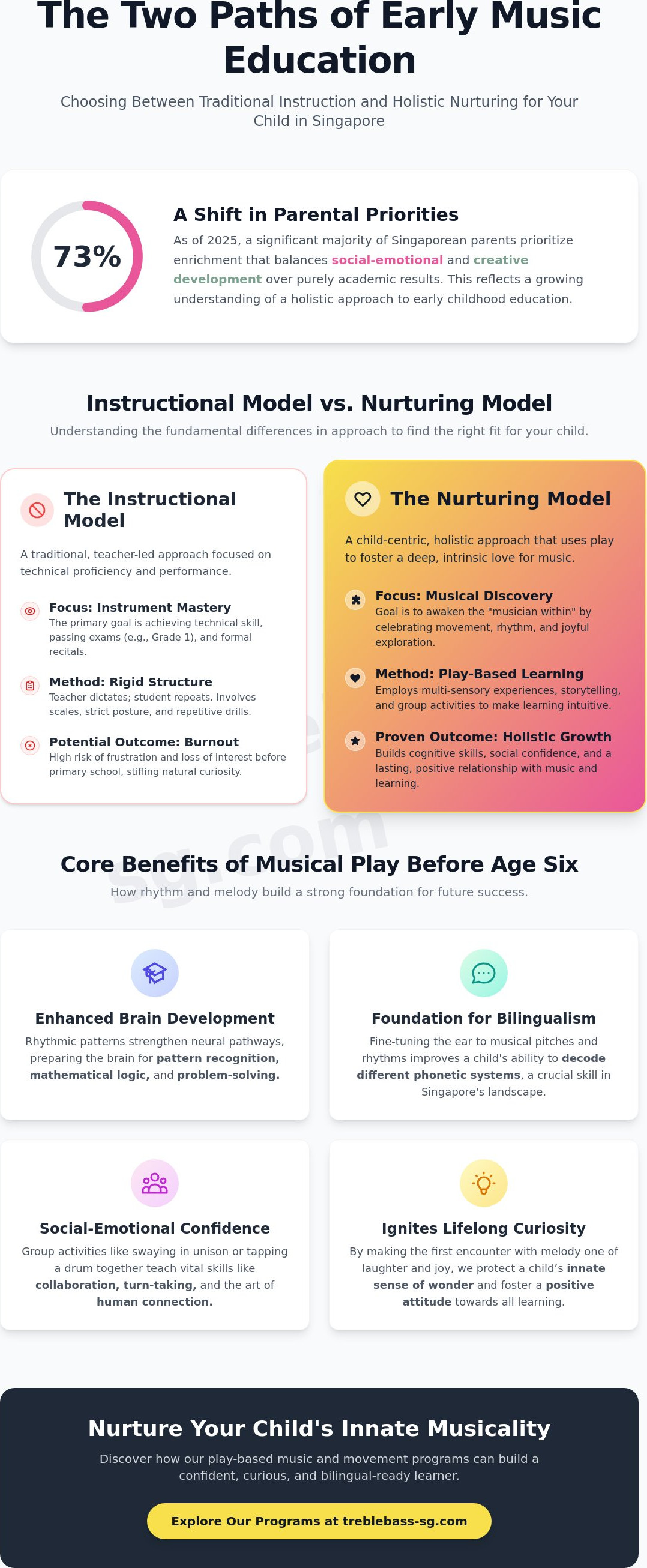
As of 2025, a significant 73% of parents in Singapore prioritize enrichment that balances social-emotional and creative development over purely academic results. We understand this shift toward a more holistic approach. You'll discover how the updated April 28, 2026, MOE Nurturing Early Learners Framework integrates music to spark joy and curiosity in every session. We'll explore how programs like English storyplay or Chinese speech and drama classes in central hubs like Holland Village create those vital "little sparks" of connection. This article outlines the path to choosing a program that honors your child's unique journey while delivering measurable cognitive benefits.
Key Takeaways
Shift your perspective from rigid instrument training to holistic music lessons that celebrate movement and joyful discovery.
Explore the link between rhythmic patterns and brain development, specifically how musicality enhances a child's ability to process new languages.
Learn how to distinguish between the instructional model and a nurturing model to ensure your child's first encounter with melody is positive and stress-free.
Uncover the benefits of integrating bilingual storytelling and drama to build the social confidence required for a successful transition to primary school.
Identify the essential qualities of a high-quality enrichment center, focusing on teacher rapport and small-group dynamics that foster meaningful connections.
Table of Contents Redefining Music Lessons for Early Learners in Singapore How Musical Play Sparks Brain Development and Language Skills Choosing Between Instrument Mastery and Holistic Music Enrichment Key Factors for Singapore Parents When Selecting an Enrichment Centre Nurturing Early Talent: The Treble Bass Approach to Music and Movement
Redefining Music Lessons for Early Learners in Singapore
Many parents in Singapore view music lessons as the first step toward a Grade 1 certificate or a formal recital. However, for a toddler or preschooler, the rigid structure of scales and strict posture can often stifle the very curiosity we hope to ignite. We believe that true musicality begins with the body, the voice, and the imagination. It's a vibrant blend of rhythm, movement, and storytelling that invites a child to experience sound rather than just study it. By focusing on "musicality" rather than "mastery" for children under six, we protect their innate joy while building a sophisticated internal clock and a sensitive ear.
Creating a fertile learning environment is essential for this development to take root. In our nurturing spaces within central Singapore hubs like Holland Village, we move away from the "Instructional Model" where a teacher dictates and a student repeats. Instead, we embrace a "Nurturing Model" that values empathy and playful discovery. This foundational stage of early childhood music education focuses on the whole child, ensuring that their first encounter with melody is one of laughter and connection rather than pressure.
The Shift from Instrument Mastery to Musical Discovery
Starting a child on a specific instrument too early can frequently lead to burnout before they even reach primary school. Their fine motor skills are still developing, and the physical demands of a violin or piano can become a source of frustration. Play-based learning sustains a child's interest by turning every rhythm into a game and every melody into a story. Holistic music enrichment is the intentional practice of using multi-sensory experiences to awaken a child’s innate sense of rhythm and melody before they ever touch a formal piano key. It's about building the "musician within" before asking them to perform for an audience.
Why Early Exposure Matters Before Age Six
The "window of opportunity" for auditory development is most critical during the first few years of life. During this period, an infant's brain is incredibly plastic, forming neural pathways that determine how they will process sound for the rest of their lives. Rhythmic patterns do more than just help a child keep time; they prepare the brain for mathematical logic and pattern recognition later on. In a group setting, these music lessons also provide vital social benefits. With preschool enrollment rates for children aged 3 to 4 reaching 90% in 2024, the ability to collaborate, wait for a turn, and sway in unison with peers has become a cornerstone of social-emotional readiness. When a child taps a drum in time with a friend, they aren't just making noise; they're learning the essential art of human connection.
How Musical Play Sparks Brain Development and Language Skills
When a child sways to a melody or taps out a steady beat, they are doing much more than simply enjoying a tune. They are actively training their brain to process sound with precision. This auditory processing is the invisible bedrock of reading readiness. In our sensory-rich environments, we focus on nurturing those "little sparks" of curiosity that help a child distinguish between different sounds and pitches. By fine-tuning the ear through music lessons, we give children the tools they need to decode the complex world of language before they ever encounter a formal textbook.
Rhythm acts as a natural scaffolding for speech. When children learn to identify the "pulse" in a song, they are simultaneously learning to recognize the rhythmic patterns of sentences. This connection is particularly powerful for language acquisition, as it helps children break down words into smaller, manageable sounds called phonemes. If you're looking for a deeper dive into these developmental connections, our guide on Music Classes in Singapore: A Parent’s Guide to Holistic Early Enrichment provides a wonderful roadmap for parents.
Rhythm as a Foundation for Bilingualism
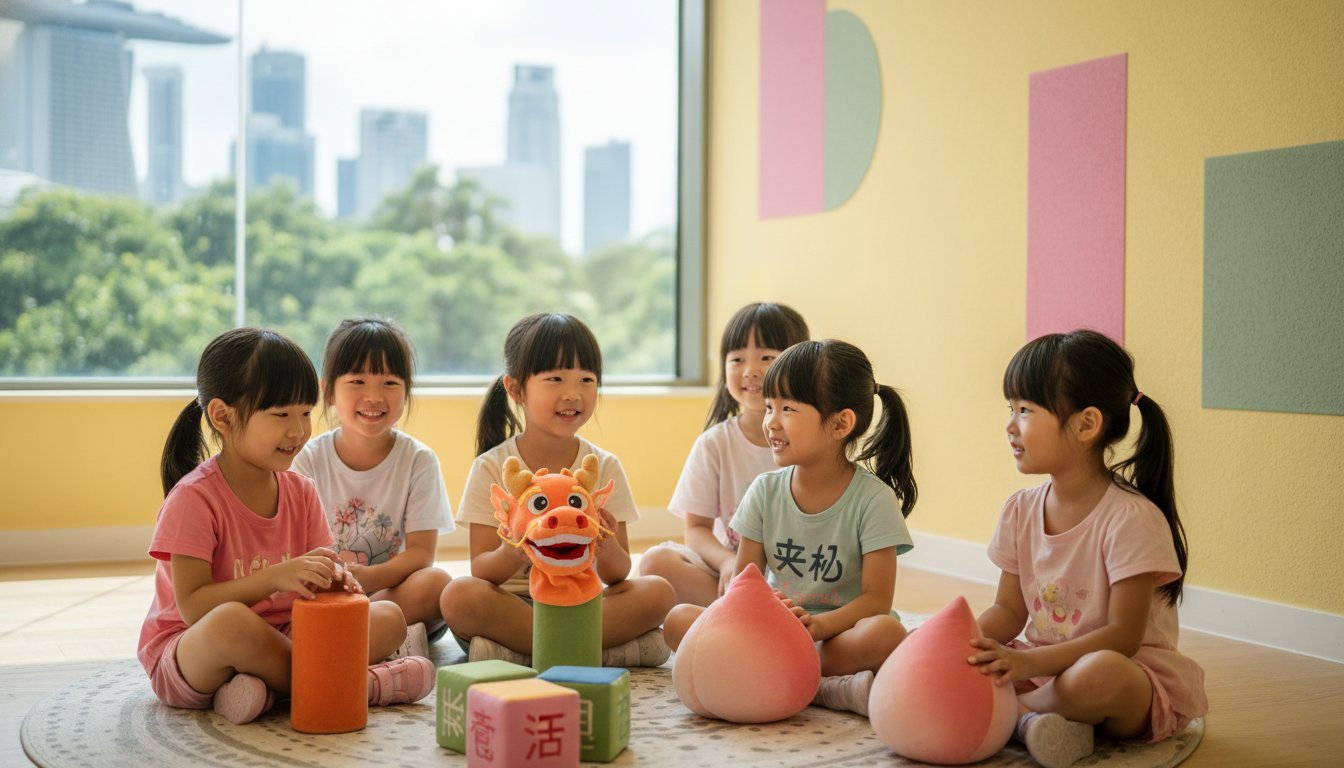
Singapore’s unique bilingual landscape requires children to navigate different phonetic systems from a very young age. Music provides a joyful bridge between English and Mandarin. In our Chinese storyplay sessions, we use the melodic contours of song to make the four tones of Mandarin feel intuitive rather than intimidating. Because rhythm is universal, "moving to the beat" helps children develop a sense of verbal fluency that translates across both languages. While 17% of enrichment programs in Singapore focus specifically on language, we find that integrating music into the curriculum creates a more fertile environment for words to take flight.
Neuroplasticity and the Power of Sound
Neuroplasticity is a scientific term for a very beautiful, nurturing concept: the brain’s incredible ability to grow and reshape itself like a thriving garden. Every time an infant or toddler is exposed to purposeful sound, new neural pathways are formed. Our Baby C (喜宝宝) style classes are specifically designed to use gentle auditory stimulation to support this growth. A landmark five-year study by the University of Southern California recently confirmed that music instruction can accelerate brain development, especially in the areas responsible for language, speech, and reading skills.
This early musical exposure has a profound long-term impact on a child's ability to focus. By learning to listen for a specific instrument or wait for a rhythmic cue, children build the mental muscle required for memory and sustained concentration. If you'd like to see these "little sparks" of potential ignite in your own little one, we invite you to explore our nurturing programs where every note is a step toward holistic growth.
Choosing Between Instrument Mastery and Holistic Music Enrichment
Deciding on the right path for your child’s musical journey often feels like a tug-of-war between two different philosophies. On one side, the "Instructional Model" focuses on technical proficiency and preparing for formal exams like the ABRSM. On the other, the "Nurturing Model" prioritizes emotional connection, story-driven play, and creative movement. Choosing the right music lessons for a toddler isn't about picking a piano teacher; it's about selecting an environment that honors their current developmental stage. While the instructional model has its place later in life, forcing a three-year-old into a rigid practice schedule can lead to a lifelong distaste for melody.
A common concern we hear from parents is the fear of "wasting time." If a child isn't learning to read notes on a page, is the class still valuable? Scientific research suggests the answer is a resounding yes. A comprehensive review by the National Institutes of Health (NIH) indicates that holistic music enrichment enhances verbal memory and executive functions far more effectively than rote technical training in early childhood. By building these internal foundations first, you're not delaying progress. You're ensuring that when they eventually pick up an instrument, they have the rhythmic steady beat and auditory sensitivity to excel with ease.
Understanding your child’s learning temperament is the first step in this choice. Some children are naturally auditory learners, mesmerized by the tiniest chime or the low hum of a cello. Others are kinesthetic learners who need to feel the vibration of a drum through their feet and express the music through their whole bodies. A nurturing program caters to both, using sensory-rich activities to engage every child's unique way of experiencing the world.
When is a Child Ready for ABRSM or Formal Exams?
Physical readiness is a significant factor in transitioning to formal music lessons. Most experts recommend a "pre-instrument" phase of one to three years to develop the necessary ear training and rhythmic coordination. Finger strength and the ability to maintain focus for a 45-minute lesson usually don't coalesce until around age six. Signs of readiness include a child’s ability to follow multi-step instructions and a genuine, self-driven curiosity about how a specific instrument creates its sound.
The Role of Speech, Drama, and Dance in Music
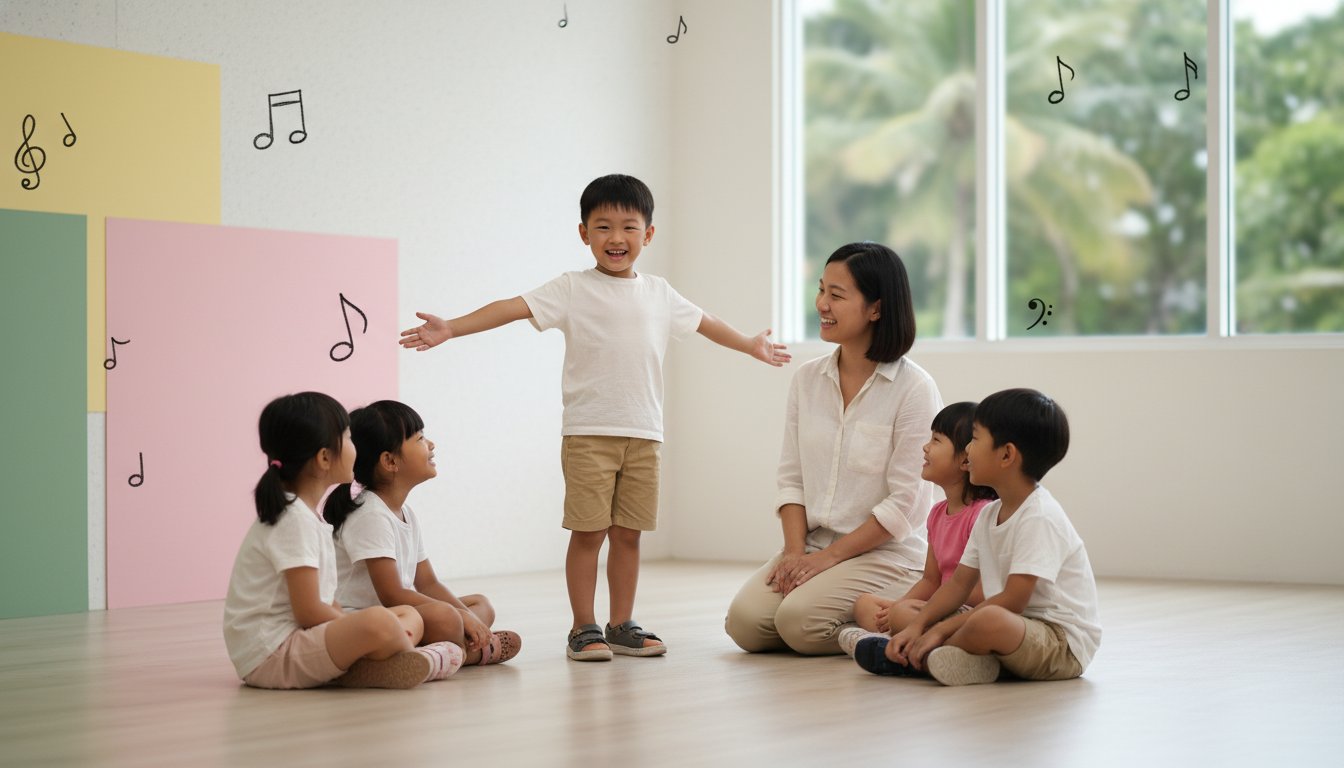
Music doesn't exist in a vacuum. It's deeply intertwined with how we move and speak. Our "Starsteps" themed dance classes help children internalize rhythm by translating beats into physical steps. Similarly, dramatic play allows a child to "become" the music, using their imagination to overcome shyness. This builds the social confidence required to eventually stand on a stage. If you're comparing different environments, our analysis of the Best Music Studio Singapore: Comparing Top Enrichment Spaces for Kids (2026) can help you find a space that values this integrated, multi-disciplinary approach.
Key Factors for Singapore Parents When Selecting an Enrichment Centre
Choosing the right space for your child's first music lessons is a deeply personal decision that goes far beyond a simple Google search. In Singapore, where the early childhood enrichment sector reached a market value of S$1.2 billion in 2025, the sheer number of options can feel overwhelming. While curriculum is important, the most critical factor for a toddler is the emotional safety of the environment. You're looking for more than just a classroom; you're seeking a community where your child feels seen, heard, and encouraged to explore their "little sparks" of creativity without the fear of making a mistake.
Location and convenience play a significant role in sustaining a long-term commitment to enrichment. Busy parents often gravitate toward central hubs like Holland Village because these areas allow for a seamless integration of classes into the family's weekly rhythm. When a center is easily accessible, the journey to class becomes a joyful part of the routine rather than a stressful commute. This ease of access ensures that both parent and child arrive at the studio with an open heart, ready for the meaningful connections that happen during a shared musical experience.
A trial class is your best opportunity to look past the marketing and see the heart of a program. During a typical 45-minute session, pay close attention to how the teacher handles the natural unpredictability of early childhood. Do they pivot gracefully when a child becomes distracted? Is there a sense of joyful purpose in the room? If you're ready to see how a nurturing environment can transform your child's confidence, we invite you to book a trial at Treble Bass and experience our philosophy of playful discovery firsthand.
Evaluating the Teacher’s Philosophy
When interviewing a potential teacher, ask whether they focus on the process or the product. For a young child, the laughter shared during a rhythmic game is far more valuable than a perfectly executed song. You want a "Nurturing Expert" who acts as a passionate mentor rather than a strict disciplinarian. Teachers with diverse artistic backgrounds in drama, dance, and music are often better equipped to engage a child's imagination, as they can draw from multiple disciplines to keep the "fertile learning environment" vibrant and exciting.
The Impact of the Physical Environment
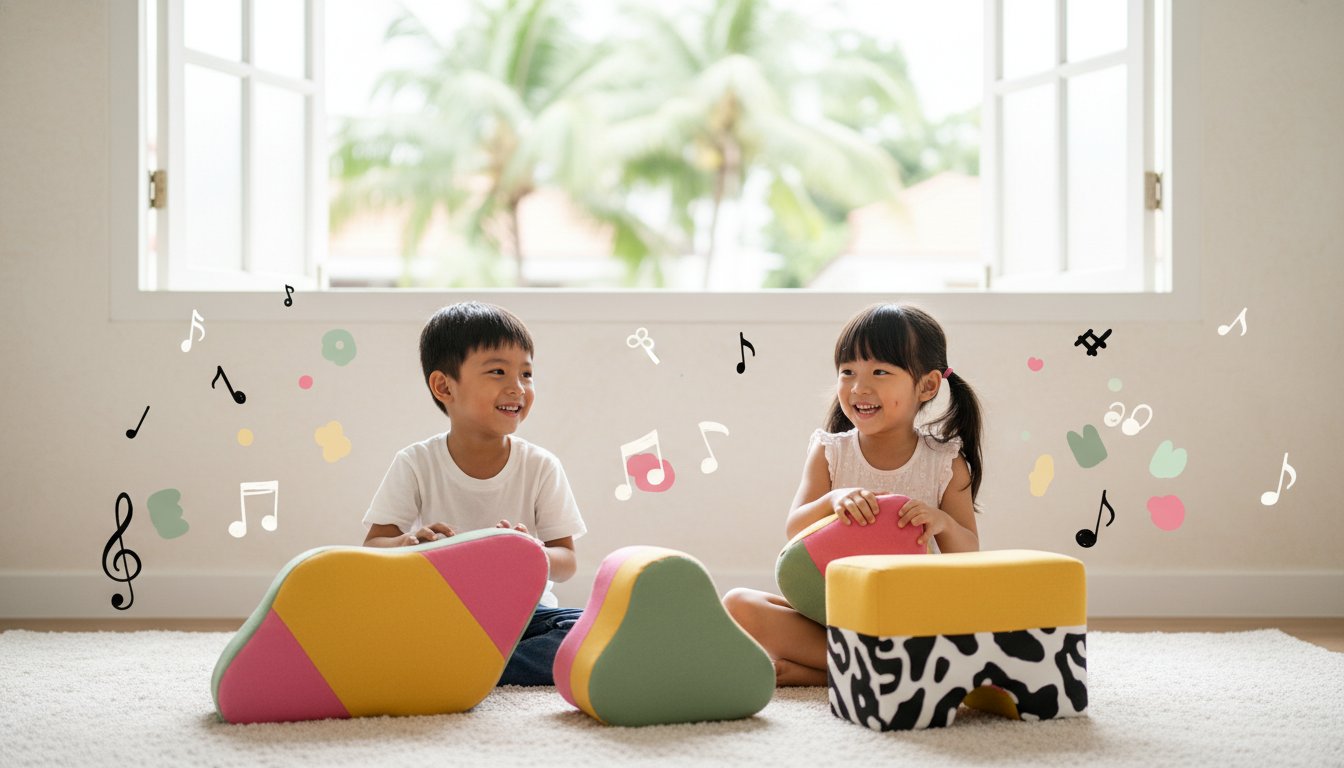
The physical space should feel like a sanctuary for the senses. Clinical, classroom-style studios can sometimes feel intimidating to a three-year-old. Instead, look for safe, sensory-rich spaces that encourage independent exploration. A well-designed studio uses metaphors of growth, providing instruments and props that are accessible to small hands. In these environments, the priority is always the bond between the parent and the child. This focus on family connection ensures that the music becomes a lived experience, fostering a sense of security that allows a child's potential to truly shine.
Nurturing Early Talent: The Treble Bass Approach to Music and Movement
At Treble Bass, we believe that music lessons should be a gateway to a child's soul rather than a list of chores to complete. We've built our philosophy around the concept of nurturing from the inside out, where the goal is to cultivate a child's innate musicality through joy and playful discovery. By creating a fertile musical learning environment, we allow every "little spark" of curiosity to grow into a steady flame of confidence. We don't just teach children how to keep a beat; we invite them into a world where melody and movement become a natural language for their emotions and ideas.
Our approach is unique in its holistic integration of different artistic disciplines. We've developed a blend of bilingual StoryPlay adventures, such as our Playtots and Bubbles programs, alongside specialized Speech & Drama sessions. This combination ensures that your child isn't just learning to hear music but is also learning to use it as a tool for communication. To round out this development, our Starsteps themed dance classes help children internalize rhythm through their whole bodies. This kinesthetic learning is essential for preschoolers, as it turns abstract musical concepts into a lived, physical experience that they can truly understand.
From Playtots to Bloomers: A Journey of Growth
The musical journey at our studio begins with the tenderest moments of infant bonding in our Baby C (喜宝宝) and Babies classes. As children grow, they transition into our Playtots and Bubbles programs for 1 to 3-year-olds, where the focus shifts toward independent creative expression. Our central Singapore studio serves as a sanctuary for these families, facilitating deep bonding through shared rhythmic games and songs. By the time children reach our Adventurers and Bloomers Speech & Drama classes for ages 3 to 6, they've built a sturdy foundation of self-assurance. We've watched many children find their voice through dramatic play, evolving from quiet observers into vibrant storytellers who aren't afraid to take up space and share their light.
Join Our Community of Joyful Learners
There's a significant difference between a traditional "tuition centre" and a joyful learning space. While a tuition center might focus on rigid results, we prioritize the process of discovery and the meaningful connections made along the way. We're a community that celebrates every milestone, no matter how small, with maternal empathy and professional expertise. Whether you're interested in our Chinese Storyplay to support bilingualism or our English Drama to build social confidence, we're here to guide your child's unique journey. We invite you to step into our world of laughter and melody to see the difference a nurturing approach can make. Experience the joy of nurturing music lessons at Treble Bass today.
Ignite Your Child's Musical Journey Today
Choosing the right path for your child’s first encounter with melody is a gift that lasts a lifetime. You've seen how music lessons that prioritize joyful movement and storytelling can accelerate language acquisition and build social-emotional resilience. By focusing on the "musician within" before the technicalities of an instrument, you're protecting your child's sense of wonder while fostering a deep, internal understanding of rhythm and harmony. This holistic foundation ensures that every step they take is filled with confidence and curiosity.
Since 2015, we've been dedicated to this nurturing philosophy through our specialized bilingual curriculum. Our central Holland Village location provides a safe, vibrant space where families gather to celebrate every small milestone. Whether your little one is swaying in our Babies class or finding their voice in our Bloomers drama sessions, we're here to facilitate those meaningful connections. We invite you to book a trial StoryPlay or Drama session at Treble Bass Holland Village. Let's work together to spark joy and nurture your child's potential from the inside out.
Frequently Asked Questions
What is the best age to start music lessons in Singapore?
You can begin as early as infancy, with specialized classes like Baby C (喜宝宝) designed for babies under 12 months. Starting early allows a child to absorb rhythmic and melodic patterns naturally during the peak window of auditory development. While formal instrument training usually waits until age six, these foundational years are critical for building a fertile musical environment within the child's mind.
Do music lessons really help with my child’s brain development?
Yes, research from the University of Southern California confirms that music lessons accelerate brain growth in areas responsible for language and reading. By engaging in active musical participation, children develop stronger neural pathways for auditory processing. This early stimulation helps them decode complex sounds more efficiently, which provides a significant advantage when they begin formal schooling and literacy training.
My child is very shy; will a music or drama class be too overwhelming?
Nurturing classes are specifically designed to be a safe sanctuary for shy children rather than a source of pressure. Teachers use maternal empathy and playful discovery to invite participation at the child's own pace. By focusing on meaningful connections and small-group dynamics, we help quiet observers gradually find their voice through dramatic play, which builds social confidence without the stress of rigid performance expectations.
What is the difference between storyplay and a standard music class?
Storyplay integrates narrative and imagination into every musical activity, whereas standard classes often focus on technical repetition or note-reading. In a Storyplay Adventure, a child might "climb a mountain" while exploring high pitches or "tiptoe through a forest" to rhythmic beats. This approach turns abstract concepts into a lived experience, ensuring that every session sparks joy and sustains a child's natural curiosity about sound.
How much do music lessons for toddlers typically cost in Singapore?
According to 2026 market data, a module of 11 parent-accompanied lessons for young children typically costs approximately S$440, which averages to about S$40 per session. Other established programs in Singapore may charge around S$608 for a package of 15 lessons. Most centers also require a one-time enrollment fee, which ranges between S$32 and S$65, and may include a material fee for instruments.
Is it better to choose a bilingual music class or a monolingual one?
Choosing a bilingual class is often beneficial in Singapore because it uses the melodic nature of music to make language acquisition more intuitive. For example, Chinese storyplay helps children grasp the specific tones of Mandarin through song and rhythm. While monolingual classes offer deep immersion, a bilingual approach supports the 17% of parents who prioritize enrichment that bridges the gap between English and a second language.
Can my child learn music through dance and movement instead of an instrument?
Absolutely, as movement is the primary way young children internalize rhythm and melody. Programs like Starsteps Themed Dance allow children to feel the music through their whole bodies, which is a vital kinesthetic learning stage. Engaging in movement-based music lessons ensures that a child develops a strong internal clock and physical coordination, which are the essential prerequisites for successfully mastering any musical instrument later in their journey.
Comments