_edited.jpg)
Dance Classes for Kids in Singapore: A Nurturing Guide to Creative Movement (2026)
What if the most important lesson your child learns in their first dance class isn't a perfect plie, but the courage to take up space and shine from the inside out? Many parents in Singapore feel the heavy pressure of choosing between rigid, exam-heavy tracks and the nagging fear of over-scheduling their little ones. When searching for dance classes for kids, it's natural to worry that a strict environment might dim the very spark of joy that makes your toddler want to sway to the music in the first place.
Finding the right fit shouldn't feel like a stressful chore. Instead, it's an opportunity to create a fertile environment for holistic growth and kinesthetic learning. This guide helps you identify the best options available in 2026, showing you how to choose a program that nurtures your child's confidence and coordination beyond just technical steps. You can even utilize the government's dollar-for-dollar matching in the Child Development Account (CDA) to invest in these meaningful experiences at approved institutions.
We'll break down the confusion surrounding different dance certifications, explore how themed movement sparks curiosity, and show you how to find a safe space where your child feels excited to discover their own potential every single week.
Key Takeaways
Learn the difference between "outside-in" mimicking and "inside-out" creative expression to find a program that truly nurtures your child's natural rhythm.
Discover how themed dance classes for kids go beyond technical steps by using sensory storytelling to accelerate cognitive development and spatial awareness.
Deconstruct common Singaporean dance certifications like RAD and CSTD to determine if a formal exam track or a creative movement approach suits your child's current needs.
Master our studio checklist to ensure your chosen environment feels warm and inviting rather than cold or clinical.
Explore the magic of story-based learning, where every lesson becomes a meaningful adventure that builds lifelong social confidence and a love for discovery.
Table of Contents
The Joy of Movement: Why Dance Classes for Kids are Essential in 2026
Before a child speaks their first word, they communicate through the gentle sway of their hips and the rhythmic bounce of their knees. In 2026, we view dance classes for kids as much more than a weekly activity; they are a fertile ground for holistic development where physical coordination meets cognitive expansion. In the high-achieving environment of Singapore, where academic excellence is often a primary focus for families, these classes provide a vital creative outlet. They act as a sanctuary that balances a child's busy schedule with pure, unadulterated joy, ensuring that their growth remains well-rounded and vibrant.
Movement serves as a child's first language. It's the primary way they explore the boundaries of their world and express complex emotions they can't yet name. As toddlers transition from natural, reflexive swaying to more intentional, structured rhythmic patterns, they aren't just learning to dance. They're learning to think with their bodies. This transition is a significant milestone in early childhood, marking the moment when innate curiosity transforms into purposeful physical expression and self-discovery.
The Developmental Power of Rhythm and Motion
Kinesthetic learning is a powerful driver for brain development in children under age 6. When a child matches their movement to a musical beat, they engage in complex auditory processing that closely mirrors the patterns found in early language acquisition. Research into the foundations of dance education shows that these rhythmic experiences help wire the brain for improved focus and memory. Proprioception, which is the body's ability to perceive its own position and movement in space, is the silent partner in every skip and hop, helping your toddler find their balance while navigating the world with newfound confidence.
Social and Emotional Milestones in the Dance Studio
The studio environment is a safe harbor for social discovery. In a group setting, children learn the subtle art of empathy and collaborative play as they move in unison or take turns leading a circle. It's a space where big emotions find a healthy, productive home. If a child feels a burst of restless energy, dance helps them regulate that feeling by turning it into a purposeful jump or a graceful spin. We love seeing those "little sparks" of personality emerge when a child realizes they're in a non-judgmental space. This emotional security is what allows them to shine, building a foundation of social confidence that stays with them long after the music stops.
Creative Movement vs. Exam-Syllabus Classes: Making the Right Choice
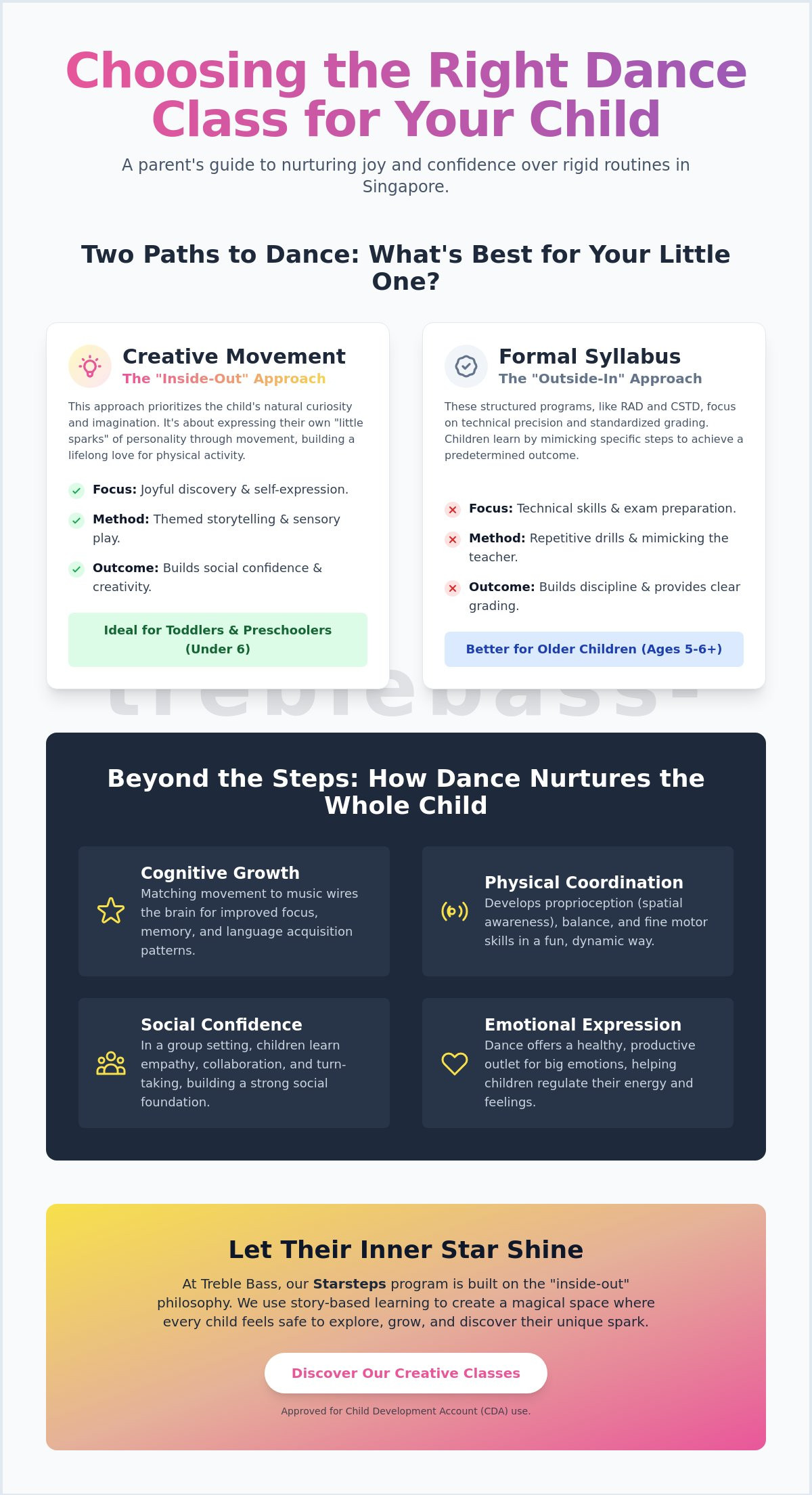
When you begin your search for dance classes for kids in Singapore, you'll likely encounter two acronyms almost immediately: RAD and CSTD. These represent the prestigious Royal Academy of Dance and the Commonwealth Society of Teachers of Dancing. Both are respected systems that focus on technical precision and standardized grading. While these pathways offer a clear sense of progression, many parents face a common worry: will my child fall behind if they don't start exams at age three? In our high-achieving local culture, it's easy to feel that a certificate is the only measure of success, but the early years of a child's life require a different kind of nurturing.
We often distinguish between "outside-in" learning and "inside-out" expression. In an outside-in approach, a child is asked to mimic a teacher's specific steps to achieve a predetermined look. While this builds discipline, it can sometimes feel clinical or restrictive for a toddler. Conversely, "inside-out" learning starts with the child's own imagination. It prioritizes the joy of discovery, allowing their natural "little sparks" of personality to lead the way. For children under age five, this creative freedom is essential for building a positive relationship with physical activity that lasts a lifetime.
Understanding Formal Dance Syllabuses (RAD & CSTD)
Formal syllabuses like RAD and CSTD are designed to build a strong foundation in ballet, jazz, and tap through specific postures and technical drills. These systems typically introduce formal exams around age 5 or 6, once a child has the physical maturity to handle repetitive movements safely. For younger children, however, a strictly standardized curriculum can sometimes feel repetitive. While the structure is valuable for older students seeking professional tracks, it may not always capture the whimsical curiosity of a three-year-old who just wants to twirl like a snowflake.
The Magic of Creative Themed Dance
Themed dance transforms the studio into a world of wonder. By using immersive storytelling, such as "Exploring the Enchanted Forest" or "Voyage to the Moon," children remain engaged up to 10 times longer than they would during traditional drills. This method supports holistic development through dance by integrating cognitive problem-solving with physical movement. If you're weighing your options, our guide on creative movement in Singapore provides more insight into why this approach is so effective for early learners.
At Treble Bass, our Starsteps philosophy is rooted in this imaginative play. We believe that when a child is invited to be a character in a story, they develop a level of confidence and social bravery that no exam syllabus can replicate. It's about nurturing the child's unique journey from the inside out. You might find that our themed dance classes are exactly the safe, joyful space your child needs to start their musical and movement journey with a smile.
Beyond the Steps: The Holistic Benefits of Themed Dance
In a world where children are often rushed from one developmental milestone to the next, themed dance classes for kids offer a rare, beautiful pause for sensory discovery. These sessions aren't just about learning a routine; they're about creating a fertile environment where physical activity and sensory play intertwine. When a child is invited to move like a soaring eagle or a creeping caterpillar, they're engaging their proprioceptive system to understand their body's boundaries and capabilities. This holistic approach ensures that every hop and turn serves a deeper purpose, grounding their physical growth in a sense of wonder and curiosity.
The cognitive benefits of this imaginative movement are profound. As children follow a narrative, they're practicing complex mental tasks like sequencing and spatial awareness. Remembering that a "sea turtle" must glide slowly before a "dolphin" can leap requires a high level of focus and memory. We approach every lesson with deep maternal empathy, recognizing that for many little ones, the dance studio is their very first step into independence. Our goal is to nurture those little sparks of rhythm, waiting for that magical moment when a child stops looking at the teacher and starts moving to the music from within their own soul.
Building Unshakable Confidence
We've designed our studio to be a "safe to fail" environment where mistakes are simply part of the adventure. This security allows even the shyest children to find their voice. It's heartening to watch the transition as a child moves from clinging to a parent's hand to dancing independently in the center of the room. By removing the pressure of a formal performance, we allow genuine self-esteem to bloom. When a child realizes they can express themselves without fear of being "wrong," they develop a social bravery that carries over into their preschool classrooms and beyond.
Language and Literacy through StoryPlay
Our curriculum draws heavily on our expertise in storyplay, creating a seamless bridge between movement and literacy. By acting out various characters, children naturally expand their vocabulary and narrative skills. They don't just hear words like "scuttle," "glide," or "pounce"; they embody them. This physical experience of language makes new concepts stick in a way that passive listening cannot. There is a beautiful synergy between our movement programs and our music classes for toddlers, as both use rhythm and storytelling to accelerate early childhood brain development and language acquisition in a joyful, stress-free setting.
Choosing the Best Dance School in Singapore: A Parent’s Checklist
Selecting the right space for your child's first steps is a deeply personal decision that goes far beyond a simple Google search. While many platforms focus solely on price and location, the best dance classes for kids are defined by the "soul" of the studio. When you walk through the doors, pay close attention to the atmosphere. Is the environment clinical and cold, or does it feel warm and inviting? A nurturing space is the fertile ground where those first "little sparks" of curiosity can safely grow into lifelong confidence.
Teacher credentials are another vital piece of the puzzle. It isn't enough for an instructor to be a talented performer; they must also be a passionate mentor who understands early childhood pedagogy. An educator who leads with maternal empathy knows how to guide a hesitant toddler with a smile rather than a rigid command. Additionally, ensure the school maintains strict age-appropriate groupings. The physical and cognitive needs of an 18-month-old are vastly different from those of a 4-year-old. Mixing these stages often leads to a "one size fits all" approach that fails to support each child's unique developmental journey.
What to Look for During a Trial Session
A trial class is your window into the heart of the program. Observe the students carefully. Is there a sense of joyful purpose in their movement, or are they simply following orders? You want to see children who are laughing and exploring, not just mimicking. Don't forget to evaluate the physical environment as well. A professional studio should feature sprung floors, which are essential for protecting a child's developing joints by providing necessary shock absorption. Safety and cleanliness are the quiet foundations of a truly high-quality learning environment.
Location and Community: The Holland Village Advantage
For busy parents in Singapore, the logistics of a weekly schedule can be a major hurdle. Choosing a central, vibrant location like Holland Village offers a significant advantage, making it easy to weave enrichment into your family's routine. Beyond the convenience, look for a community-oriented center where you can connect with other families. This sense of belonging turns a simple lesson into a meaningful bonding experience for both you and your child. We always recommend taking a "nurturing tour" of the facility to meet the team and feel the energy of the space first-hand. If you're looking for a place where your child's potential is truly celebrated, you can book a trial for our Starsteps themed dance classes to experience our nurturing approach today.
Starsteps at Treble Bass: Where Every Child Finds Their Spark
After exploring the developmental landscape of early movement, it becomes clear that the most effective dance classes for kids are those that treat the studio as a canvas for the imagination. Starsteps is the heart of our movement philosophy at Treble Bass, serving as the logical conclusion to a nurturing, child-centered education. We've removed the weight of "exam-track" expectations to create a space where your child's natural rhythm can flourish without the shadow of a grade. Here, we don't just teach steps; we invite children to inhabit a story, ensuring that their first experience with dance is one of pure, unbridled joy.
A typical Starsteps class flows with a sense of playful discovery. We begin with story immersion, where our faculty-who act as passionate mentors rather than rigid instructors-set the scene for the day's adventure. From there, children transition into creative movement, where the technical foundations of dance are woven into the narrative. This approach ensures that while they're learning to leap and twirl, they're also developing the social confidence and emotional regulation skills we've discussed throughout this guide. Our "No Exam Pressure" guarantee means that every child progresses at their own pace, protected by a team that values their unique journey from the inside out.
The Starsteps Curriculum: A Journey through Imagination
To keep curiosity high and engagement deep, our themes change every term. One month might find our dancers exploring an enchanted forest, while the next sees them voyaging through the stars. We utilize a variety of sensory props to deepen the experience:
Silk Scarves: Used to teach fluidity and grace as they become butterfly wings or drifting clouds.
Rhythmic Ribbons: These help children visualize the path of their movement in space.
Drums and Shakers: Essential tools for grounding their kinesthetic learning in a steady beat.
By focusing on these sensory-rich experiences, Starsteps builds the core physical and cognitive foundations that prepare children for any future dance genre they might choose to pursue later in life.
Join Our Community of Joyful Dancers
We invite you to step into our Holland Village center and feel the difference that a nurturing expert can make. From the moment you walk in, you'll find a warm welcome and a community of parents who value holistic growth just as much as you do. Our enrollment process is designed to be as stress-free as our classes, beginning with a trial session where you can witness your child's "little spark" first-hand. We're here to ensure that every hop, skip, and jump is a meaningful step toward a confident future. Book a Starsteps Trial and let your child’s spark shine!
Nurture Your Child's Natural Rhythm Today
Choosing the right dance classes for kids is about more than just finding a convenient time slot; it's about selecting a sanctuary where your child's confidence can bloom. We've explored how themed movement transforms technical drills into imaginative adventures, helping toddlers develop everything from proprioception to early literacy. By prioritizing a nurturing environment over rigid exam pressure, you ensure that your little one's first experience with rhythm is defined by laughter and curiosity. This approach fosters a lifelong love for movement that starts from the inside out.
Since 2015, Treble Bass has dedicated over a decade to sparking these little joys in families across Singapore. Our specialized Starsteps curriculum is crafted with maternal empathy to support holistic growth from our central Holland Village studio. We believe every child deserves a fertile environment to discover their unique rhythm and shine with social confidence. Discover the Joy of Starsteps Themed Dance. Book a Trial Today! We look forward to welcoming your family into our community and watching your child's potential take flight with every joyful step.
Frequently Asked Questions
At what age should my child start dance classes in Singapore?
Children can begin their journey into movement as early as 18 months or 2 years old in specialized dance classes for kids. At this tender age, the focus is on natural rhythm and developing gross motor skills rather than rigid technique. By starting early, your child has a safe space to explore their physical boundaries during a critical window of brain development, fostering a sense of joy that lasts a lifetime.
What is the difference between creative movement and ballet for toddlers?
Creative movement uses storytelling and imagination to drive physical activity, while traditional ballet focuses on mastering specific positions and technical drills. For a toddler, creative movement is often more engaging because it taps into their natural curiosity and desire to play. This "inside-out" approach ensures that they develop a genuine love for dance before moving into the more structured requirements of a formal syllabus later.
Will my child be able to switch to a formal RAD ballet class later if they start with Starsteps?
Yes, starting with Starsteps provides an excellent foundation for any formal syllabus like RAD or CSTD. Our curriculum focuses on building core strength, balance, and coordination through imaginative play. These physical foundations ensure that when your child is ready for the technical demands of a formal ballet class around age 5 or 6, they already possess the body awareness and confidence needed to succeed.
What should my child wear to their first dance class?
For a first session, your child simply needs comfortable, stretchy clothing that allows for a full range of motion. While many little ones love wearing a leotard or a tutu to feel like a dancer, it isn't a requirement. We often recommend bare feet or non-slip socks to ensure safety on our professional sprung floors as they explore new ways to move with confidence and joy.
How long are the dance sessions for preschoolers?
Our Starsteps sessions are typically 45 to 60 minutes long, which is the ideal duration for a preschooler's attention span. This timeframe allows for a complete journey from the initial story immersion to the final creative movement sequence. We find that this rhythm keeps energy levels high while ensuring the children remain fully engaged in the magic of the lesson without becoming overtired.
Can parents join in the dance class at Treble Bass?
Starsteps is designed as an independent class to help children build social confidence and self-reliance away from their parents. While we encourage this independence, we understand that every child's journey is unique. Parents are always welcome to observe during trial sessions or special showcase days to witness those "little sparks" of progress and celebrate their child's growing autonomy in a safe, supportive environment.
How do dance classes help with my child’s school readiness?
Enrolling in dance classes for kids significantly boosts school readiness by improving a child's ability to follow multi-step instructions and work within a group. The rhythmic patterns we use also support early literacy and language acquisition. These social and cognitive skills provide a strong head start, helping your child feel more secure and prepared when they transition into a formal primary school setting.
What if my child is very shy and refuses to join in?
We approach every shy child with deep maternal empathy, allowing them to observe from the sidelines until they feel safe enough to join. There is never any pressure to perform immediately. Often, a child who watches quietly is still absorbing the rhythm and story. We find that with a little patience and gentle encouragement, even the most hesitant dancers eventually find their spark and join the fun.


Comments