_edited.jpg)
Drama Class for Shy Toddlers in Singapore: A Nurturing How-To Guide
Imagine standing at the classroom door while your little one clings tightly to your leg, their eyes wide with a mix of curiosity and quiet fear. You see other children laughing, yet your heart sinks as you wonder if your child is being left behind socially. It's a common worry for parents in a city where 73% of families now prioritize enrichment that balances social-emotional growth with creativity, according to 2025 industry data. Finding the right drama class for shy toddlers Singapore can feel overwhelming when you're anxious about tantrums or your child "freezing up" in front of others.
We believe every child's spark glows at its own pace. This guide reveals how specialized storyplay and gentle drama techniques can transform that hesitation into a joyful sense of "I can." You'll learn how a nurturing, safe environment allows for social experimentation, helping your toddler gain the confidence to greet a friend or express a big idea. We'll walk through how our play-based approach builds language skills and emotional resilience, turning quiet whispers into confident smiles and ensuring your child feels seen, heard, and celebrated.
Key Takeaways
Understand why shyness is a natural "slow-to-warm" temperament and how a low-stakes environment creates a safe space for your child's first social steps.
Explore how a specialized drama class for shy toddlers Singapore uses "rhythm in me" techniques to help children physically regulate anxiety and accelerate language acquisition.
Identify the critical differences between performance-based schools and nurturing boutique environments where small class sizes prioritize your child's emotional comfort.
Master a 5-step transition guide to prepare your toddler at home using familiar stories and rhythmic movement games that build gentle familiarity.
Discover how English and Chinese storyplay programs like Bubbles and Playtots focus on holistic development to transform hesitation into joyful, lasting confidence.
Table of Contents
Understanding Shyness: Why a Drama Class for Shy Toddlers in Singapore Works
The Science of Storyplay: Building the "Rhythm in Me" and Social Bravery
Evaluating Drama Classes: Nurturing Environments vs. Performance-Based Schools
How to Prepare Your Shy Toddler for Drama Class: A 5-Step Transition Guide
Sparking Joy: How Treble Bass Nurtures Confidence from the Inside Out
Understanding Shyness: Why a Drama Class for Shy Toddlers in Singapore Works
Shyness isn't a personality flaw to be fixed; it's a unique way of observing and processing the world. Many parents feel a quiet tug of worry when their little one hides behind a leg at a playgroup. However, Understanding Shyness helps us recognize this as a "slow-to-warm" temperament. This natural cautiousness often belongs to children who are deeply thoughtful and sensitive to their surroundings. In a drama class for shy toddlers Singapore, we don't aim to push children into the spotlight. Instead, we create a low-stakes environment where social interaction feels like a gentle, rhythmic invitation rather than a social requirement.
For toddlers between the ages of 1 and 3, social growth often happens through parallel play. They may not be ready to engage in a direct dialogue, but they feel secure swaying with a colorful scarf while watching a peer do the same. This shared kinesthetic learning builds a sense of belonging without the pressure of direct eye contact. It's one reason why 73% of Singaporean parents are now seeking enrichment that prioritizes emotional intelligence and social-emotional learning over traditional rote memorization. They recognize that a child who feels safe is a child who is ready to learn.
The "Slow-to-Warm" Toddler in a Social World
You might see your toddler "freeze" when a stranger says hello or cling tighter during a new activity. These aren't signs of failure; they're signs that your child needs a little more time to map out their environment. Forcing these interactions often backfires, leading to increased anxiety. A nurturing drama class for shy toddlers Singapore acts as a safe laboratory for personality exploration. Within the safety of a story, a child can experiment with being a brave explorer or a curious animal. This "pretend" world allows them to test social boundaries and practice language acquisition in a space where there's no "wrong" way to participate.
Drama vs. Performance: The Crucial Difference
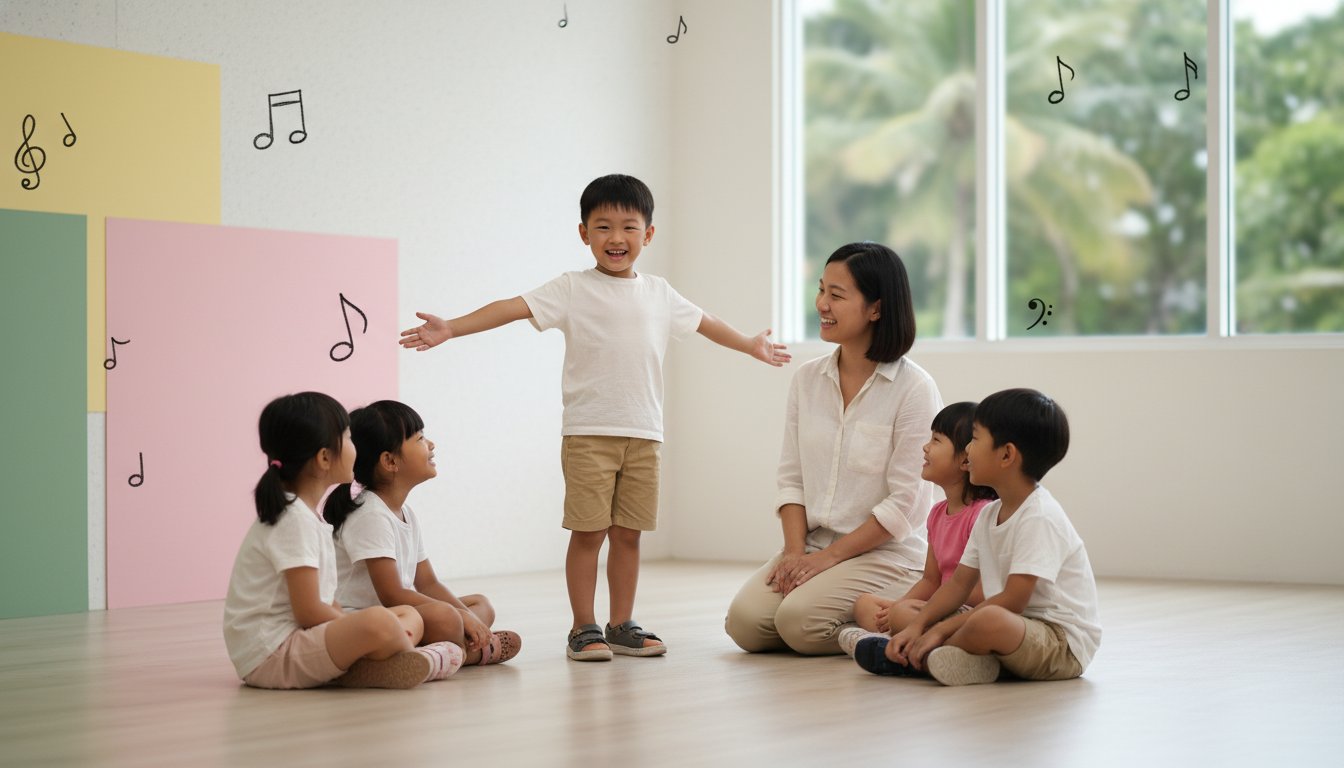
It's vital to distinguish between a performance-based school and a process-oriented drama environment. For a shy child, the idea of a "final show" with bright lights and an audience can be overwhelming. Nurturing drama is about the internal experience, not the external applause. We focus heavily on Storyplay to remove spotlight anxiety. Storyplay is a child-led journey of imagination where every little spark of curiosity is celebrated. Because there are no lines to memorize or rigid positions to hold, children can lose themselves in the magic of the narrative. This immersive experience helps them find the "rhythm in me," allowing their natural confidence to bloom from the inside out.
The Science of Storyplay: Building the "Rhythm in Me" and Social Bravery
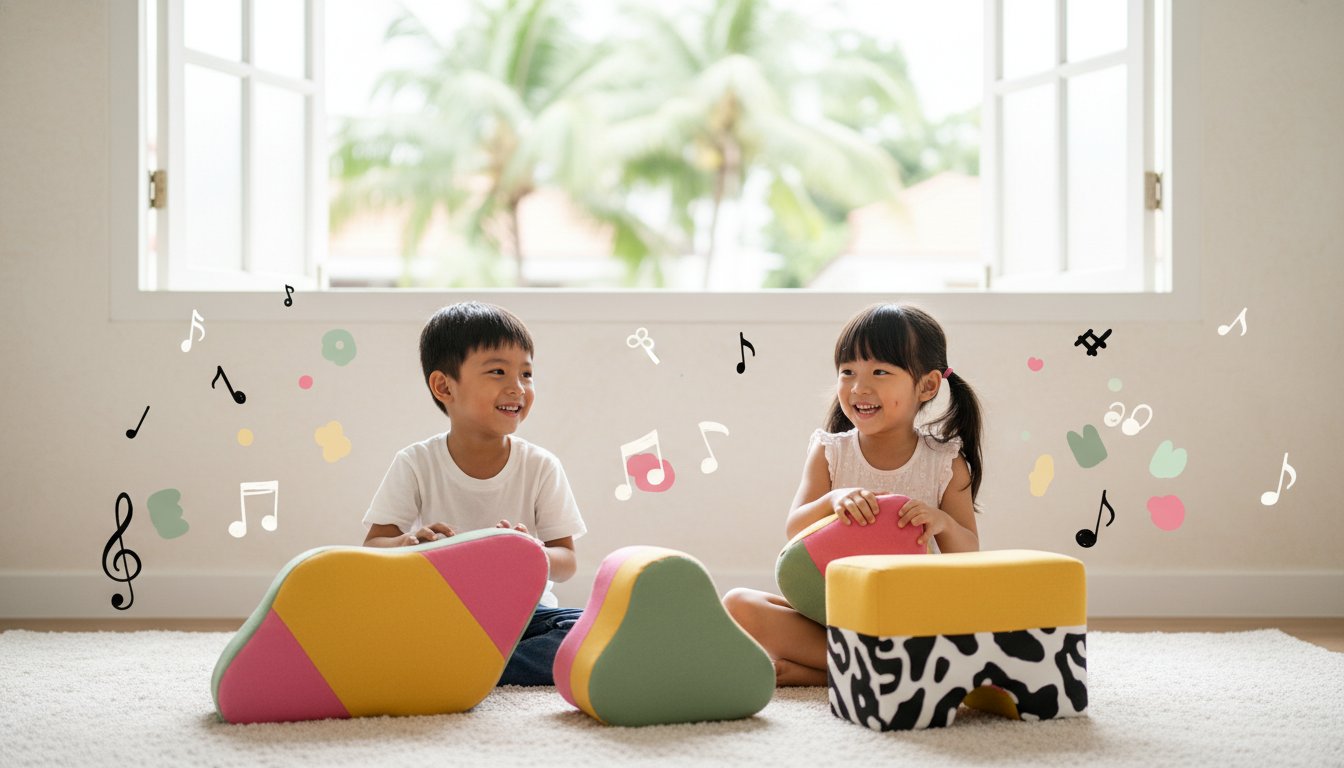
Children don't just think with their minds; they learn with their whole bodies. For a child who feels a bit hesitant, the physical sensation of a steady beat acts like an anchor. This is the heart of the "rhythm in me" philosophy. When we introduce a drama class for shy toddlers Singapore, we aren't just teaching them to act. We're using rhythmic movement to help them regulate their nervous systems. Scientific research into early childhood development suggests that synchronized movement can lower cortisol levels, the hormone associated with stress. By swaying together or tapping a drum in unison, shy toddlers find a sense of calm that makes social bravery possible.
Sensory props play a vital role in this journey. A soft silk scarf or a colorful beanbag serves as a bridge between the child and the teacher. It provides a tangible point of focus, shifting the attention away from the child's self-consciousness and toward the shared activity. This indirect interaction is far less intimidating than direct eye contact. Over time, these small moments of engagement build a fertile musical learning environment where curiosity can eventually outweigh caution. This predictable safety is reinforced through repetitive storytelling, which allows children to anticipate what comes next, reducing the fear of the unknown.
Rhythm as a Tool for Emotional Regulation
A steady, predictable beat provides a sense of security that words alone cannot offer. Kinesthetic learning allows shy children to express themselves through their bodies before they are ready to use their voices. At Treble Bass, we use music and dance to ground our learners, ensuring they feel physically safe in the space. This grounding is essential because it transforms the classroom from a place of potential "freezing" into a playground of discovery. When a child feels the rhythm in their feet, they are less likely to feel trapped by their own hesitation.
Language Acquisition Through Dramatic Play
Dramatic play is a powerful engine for language acquisition. When a toddler mimics the sound of a roaring lion or a whispering wind, they are practicing phonics and vocabulary without the pressure of a formal "lesson." Our bilingual storyplay programs, such as Bubbles and Playtots, encourage children to find their own voices through imaginative prompts. We look for those "little sparks" of communication, a whispered word, a pointed finger, or a shared laugh, and nurture them with maternal empathy. By repeating stories and songs, we create a predictable safety that allows shy toddlers to eventually join in at their own pace, expanding their vocabulary through the joy of play.
By integrating these rhythmic and sensory elements, a drama class for shy toddlers Singapore becomes more than just an enrichment activity. It's a transformative tool for holistic development that celebrates every child's unique journey.
Evaluating Drama Classes: Nurturing Environments vs. Performance-Based Schools
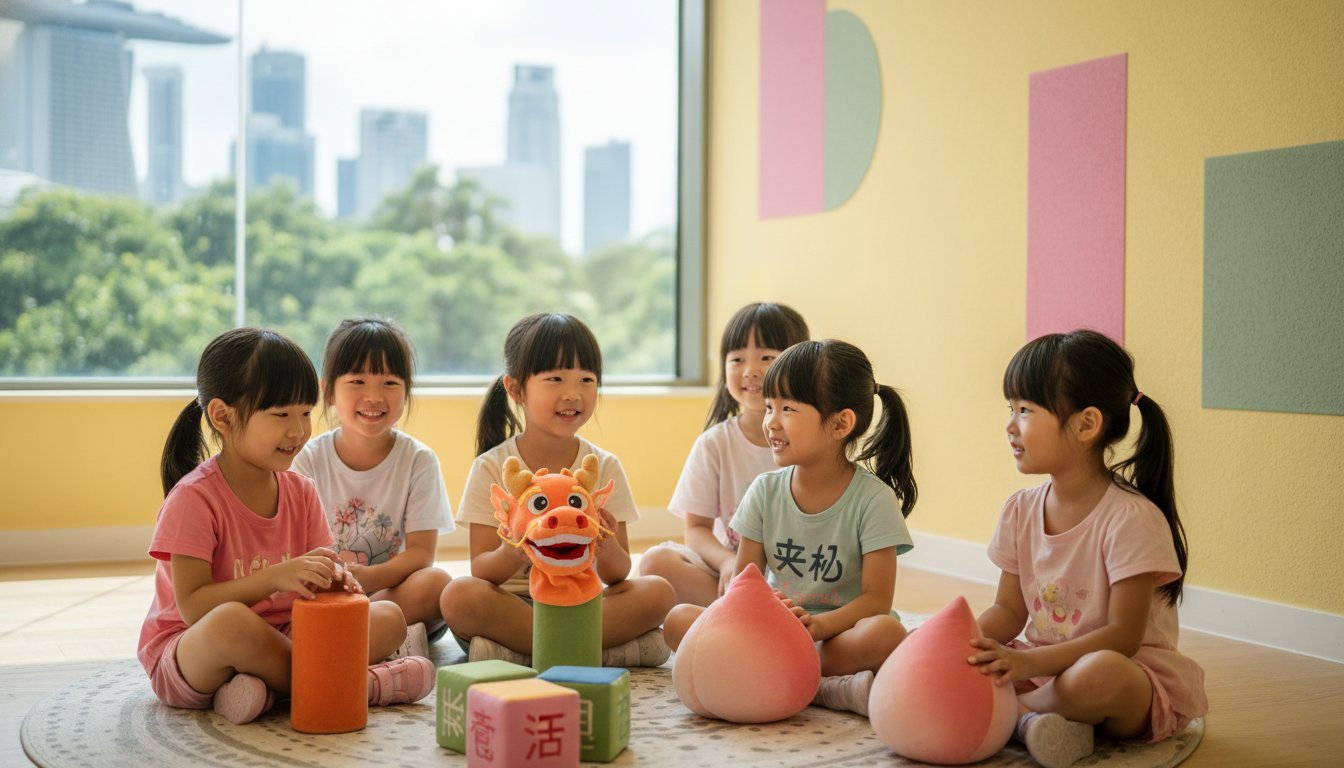
Choosing the right drama class for shy toddlers Singapore requires looking beyond shiny stage lights and impressive costumes. For many parents, the choice is between a performance-based academy and a nurturing boutique environment. In a performance-focused school, the goal is often the final curtain call. For a shy child, this pressure can feel like a heavy weight. A nurturing space, like our boutique settings in Holland Village, prioritizes the child's emotional comfort. Here, the environment feels like a home away from home, where swaying to a rhythm is more important than hitting a mark on a stage.
Class size is perhaps the most critical factor for a "slow-to-warm" child. In a large group, a shy toddler can easily disappear or feel overwhelmed by the noise. Smaller groups allow the teacher to act as a mentor rather than a director. A director gives orders to achieve a result; a mentor offers maternal empathy to build a connection. This individual attention ensures that every "little spark" of curiosity is noticed and encouraged. If your child is more comfortable in their mother tongue or you want to introduce a new language gently, bilingual options like Playtots or Adventurers Chinese storyplay provide a safe way to explore sounds and stories without the pressure of academic drills.
What to Look for During a Trial Class
A trial class is your best window into a school's heart. Don't just watch your child; watch the teacher. Observe how they handle a toddler who refuses to join the circle or clings to a parent's lap. A nurturing educator won't force the child. They will use gentle, inviting gestures and sensory props to spark joy from a distance. The physical space should feel warm and inviting, not clinical or cold. It should be a fertile musical learning environment where laughter is more common than rigid instruction.
Nurturing Philosophy vs. Exam-Oriented Results
At age two or three, your child doesn't need an acting certification or an individual instrument grade. They need holistic development. While some schools focus on exam-oriented results, we believe in nurturing confidence from the inside out. The goal is a child who can confidently greet a neighbor, not one who can recite a script under pressure. If you're wondering which path is right for your little one, you might find our guide on Speech and Drama vs Dance Class for Toddlers in Singapore helpful. Ultimately, the best choice is the one that makes your child feel safe enough to shine.
How to Prepare Your Shy Toddler for Drama Class: A 5-Step Transition Guide
The journey toward social confidence doesn't begin at the classroom door. It starts in the quiet, safe corners of your home. Preparing for a drama class for shy toddlers Singapore requires a gentle touch and a bit of playful foresight. By creating a bridge between the familiar and the new, you help your child feel like an explorer rather than a stranger. Here is our nurturing 5-step guide to making that first transition seamless and joyful.
Step 1: Read stories about "first days." Use picture books to illustrate new adventures. When characters navigate their own "slow-to-warm" moments, your toddler learns that hesitation is a normal part of a brave journey.
Step 2: Play "Rhythm in Me" games. Start simple. Clapping to a beat or swaying together to a favorite song builds physical familiarity with the activities we do in class. This kinesthetic foundation makes the eventual classroom experience feel like a game they already know.
Step 3: Visit the Holland Village area beforehand. Familiarity with the surroundings reduces environmental stress. Take a gentle stroll past our center or grab a snack nearby so the location becomes a "happy place" in their mental map.
Step 4: Master the "Safe Exit" strategy. Avoid sneaking away, as this can spark panic. Instead, establish a short, consistent goodbye ritual. A special high-five or a "mommy will be right outside" whisper provides the security they need to turn toward the teacher.
Step 5: Celebrate the "Little Sparks." After class, focus on their effort. Did they hold a prop? Did they sway to the music? Praising these small moments of participation reinforces their inner bravery more than focusing on a "perfect" performance.
The Power of Pre-Class Rituals
Rituals act as an emotional anchor for young children. You might create a "drama bag" containing a favorite pair of socks or a small transition object to bring along. Simple role-play at home, such as pretending to be a quiet mouse or a tall tree, mirrors our class structure in a low-pressure way. Familiarity breeds bravery in the toddler brain by anchoring new experiences to a foundation of known safety. When the classroom routine feels like a lived experience from home, the "freeze" response naturally melts away.
Managing Parent Anxiety During the Transition
It's natural to feel a flutter of worry when your child hesitates. However, toddlers are incredibly intuitive; they mirror your emotional state. If you project calm and excitement, they'll feel that the environment is safe. Trust the nurturing expert in the room to guide your child through their quiet moments. Every teacher at Treble Bass is trained to meet your child exactly where they are. For more insights on choosing the right path, explore The Best Speech and Drama for Kids in Singapore: A Nurturing 2026 Guide. Ready to see those little sparks fly? Book a visit to our Holland Village studio and start your child's journey today.
Sparking Joy: How Treble Bass Nurtures Confidence from the Inside Out
At Treble Bass, we believe that the most meaningful growth happens in a space that feels like a second home. Our boutique Holland Village studio is designed to be a fertile musical learning environment where every child feels safe enough to explore. For parents seeking a drama class for shy toddlers Singapore, our Bubbles English storyplay and Playtots Chinese storyplay programs offer the perfect blend of structure and spontaneity. These sessions aren't about rote learning; they're about sparking joy through holistic development. By integrating music, movement, and narrative, we ensure that your child's first social steps are filled with wonder rather than worry.
Our bilingual approach is a cornerstone of our philosophy. Whether your little one is swaying to a Chinese folk song in Playtots or discovering new vocabulary in Bubbles, they're building language acquisition skills without the pressure of a traditional classroom. This exposure to different auditory patterns at a young age helps accelerate brain development while fostering a deep, emotional connection to language. We treat every child's journey as unique, valuing their quiet observations as much as their vocal participation. This ensures that the rhythm of the class matches the rhythm of the child.
Our Nurturing Experts and StoryPlay Adventures
Our StoryPlay Adventures are guided by passionate mentors who strike a delicate balance between artistic vibrancy and maternal empathy. We understand that a shy toddler needs more than just a teacher; they need a protective guide who celebrates their "little sparks" of courage. Parents often tell us how their children, who once "froze up" in other settings, now skip into our studio with shining eyes. One mother recently shared that her daughter went from hiding behind her legs to confidently greeting her peers within just one term. This transformation isn't forced. It's the natural result of an environment that values empathy and confidence as much as musical proficiency.
Your Child’s Next Steps Toward Confidence
Taking that first step toward a drama class for shy toddlers Singapore is a simple, welcoming process. You can book a trial session for either our English or Chinese storyplay programs to see the magic firsthand. When you arrive at our Holland Village studio, just bring your child's curiosity and a pair of comfortable socks. We'll handle the rest, from the sensory props to the inviting smiles. This is more than just a tuition center; it's a community dedicated to family bonding and your child's entire well-being.
Book a Nurturing Trial Class for Your Toddler Today
Watching Your Child's Confidence Bloom
Every child's journey toward social bravery is unique. By prioritizing a process-oriented approach over performance pressure, you give your toddler the space to grow from the inside out. We've explored how rhythmic movement grounds the nervous system and how a specialized bilingual curriculum supports language acquisition in a low-stakes way. Choosing the right drama class for shy toddlers Singapore is truly about finding a sanctuary where maternal empathy guides every session.
Since 2015, Treble Bass has provided over a decade of nurturing experience within our boutique Holland Village studio. We don't just teach drama; we nurture "little sparks" of curiosity across our English and Chinese programs for children aged 1 to 6. Our focus remains on holistic growth, ensuring that every session feels like a joyful discovery rather than a rigid lesson. We value the meaningful connections made between parent and child during these early years of wonder.
Join our next StoryPlay Adventure and see your child’s confidence spark!
Your little one’s voice is waiting to be heard, and we're here to help them find it through the magic of play and heartfelt connection. We look forward to welcoming you into our joyful community and celebrating your child's unique journey together.
Frequently Asked Questions
Is my child too shy for a drama class for toddlers in Singapore?
No child is too shy for our nurturing environment. In fact, shyness is often a sign of a thoughtful observer who is deeply processing their surroundings. A drama class for shy toddlers Singapore is specifically designed to provide a low-stakes laboratory where quiet children can thrive at their own pace. We celebrate the slow-to-warm temperament and never force participation, ensuring your child feels safe before they choose to shine.
How long does it take for a shy child to start participating in drama class?
Every child's timeline is unique, but most toddlers begin to engage more actively within three to five sessions. Initially, your child might prefer to observe from your lap, which is a valid and important form of learning. As the classroom routine becomes familiar and trust is built with the teacher, you'll notice small shifts like swaying to the rhythm or reaching for a sensory prop during storytime.
What is the difference between storyplay and a regular speech and drama class?
Storyplay is a process-oriented approach that focuses on the internal journey of imagination rather than a final stage performance. While regular speech and drama often emphasize elocution and acting for an audience, storyplay uses immersive narratives to build emotional intelligence. It's a child-led experience where we use music and movement to explore a story's themes, making it much less intimidating for hesitant learners who aren't ready for the spotlight.
Will drama classes help with my child’s language development?
Yes, drama classes significantly accelerate language acquisition by connecting words to physical actions and emotional experiences. Through repetitive songs and character mimicking, toddlers practice phonics and vocabulary in a joyful, stress-free context. This kinesthetic learning helps solidify new language patterns in the brain, turning quiet whispers into confident communication as they find their own voice within the safety of a shared story adventure.
What should I do if my child cries or refuses to participate in the first class?
Stay calm and trust the process, as your toddler often mirrors your emotional state during transitions. Our teachers are nurturing experts who use maternal empathy to handle these moments with patience and gentle care. If your child needs to watch from the sidelines for the entire first session, that's perfectly okay. We focus on creating a fertile musical learning environment where the invitation to play is always open but never forced.
Are there bilingual drama options for toddlers at Treble Bass?
We offer specialized bilingual programs including Playtots for Chinese storyplay and Bubbles for English storyplay, both designed for ages 1 to 3. These classes provide a gentle introduction to a second language through music and imaginative play. For older children, our Adventurers and Bloomers programs continue this holistic development in both languages, ensuring a smooth transition as their communication skills and social confidence grow together.
How do I know if the "rhythm in me" approach is working for my child?
You'll see the "rhythm in me" approach working when your child begins to use movement to regulate their own emotions or express joy. Look for subtle signs like swaying to a beat at home or tapping a rhythm on their leg when they hear a familiar song. These physical markers indicate that your child is developing inner confidence and grounding themselves, which are the essential building blocks for social bravery in a drama class for shy toddlers Singapore.
Comments